
Repertoire
From timeless classics
to passionate drama
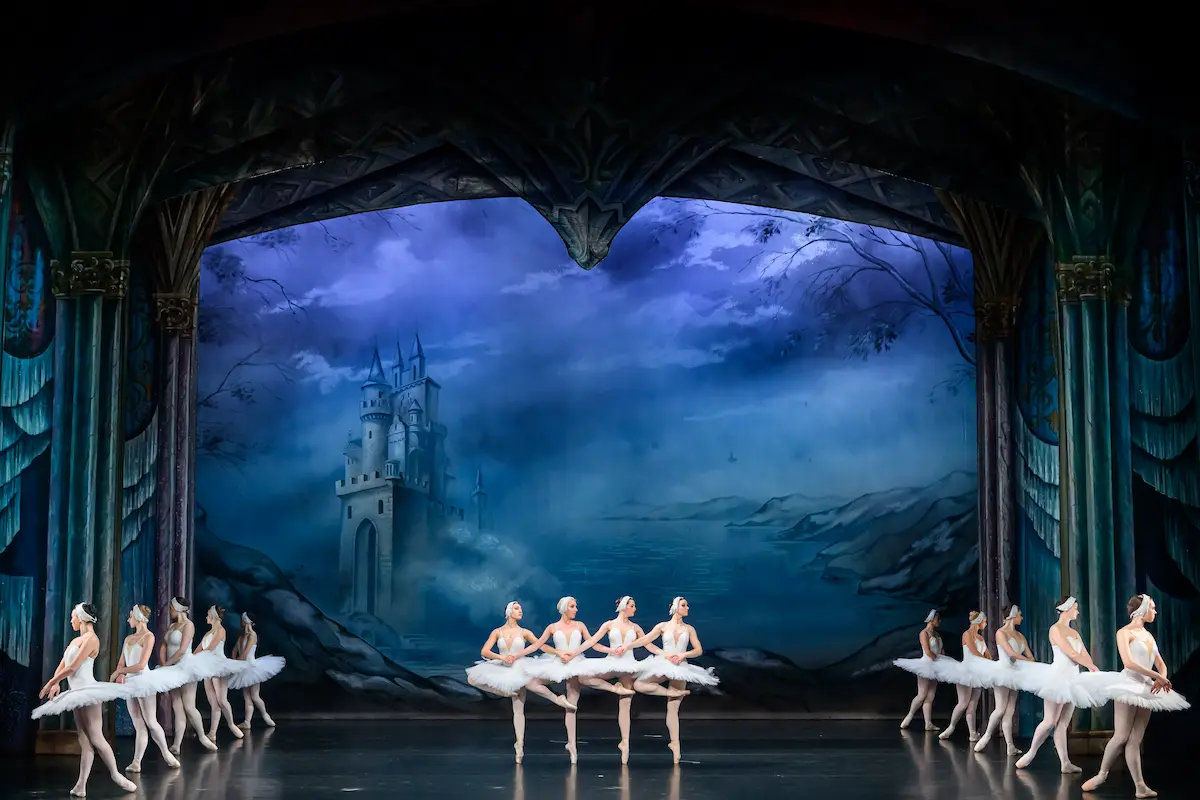
SWAN LAKE
Music by Pyotr Ilyich Tchaikovsky
Choreography:
Marius Petipa, Lev Ivanov
ACT I — The Palace & The Lake
The Palace Courtyard,
late afternoon
It is Prince Siegfried’s 21st birthday. Young people have gathered to celebrate the occasion, including the Prince’s friend Benno and Wolfgang, his old tutor. The festivities are spirited with dancing and games. In the midst of the activity, the Prince’s mother arrives to remind her son that his coming of age is a serious affair – it is a time for him to marry. A ball has been arranged for the following evening where he is to choose a bride. Siegfried is disconsolate at the thought of his carefree youth slipping away.
By the lake – evening
The hunting party follows the swans through the woods. Siegfried’s attention is attracted by a beautiful white swan which is transformed into a lovely young maiden. She is Odette, Queen of the Swans. The evil sorcerer Von Rothbart holds her under his spell – by day she and her friends are swans, except between midnight and dawn. Only the pure love of a young man can remove the curse. Astonished by her beauty, Siegfried vows his love. As dawn breaks, the lovers bid farewell, and Von Rothbart plots to make the Prince break his vow.
ACT II — The Ballroom & The Finale
The Castle Ballroom –
the following evening
The entire court is assembled for Siegfried’s betrothal ball. The Prince’s mind is still filled with images of Odette, and he pays little attention to the eligible young women presented to him. Suddenly, Von Rothbart arrives disguised as a nobleman with his daughter Odile. Transfixed by her likeness to Odette, Siegfried is bewitched and asks for her hand in marriage. Triumphantly, Von Rothbart and Odile reveal themselves. The Prince realizes too late that he is a victim of treachery. In despair, he runs to the lake to search for Odette.
The Lake – later that evening
Overwhelmed with grief, Odette tells her friends of the betrayal. Siegfried rushes to her, explaining that in Odile he saw his Odette. Von Rothbart, in a rage, summons a storm with lightning. But nothing can break their pure love. Von Rothbart himself enters into combat with the Prince and dies. His charms collapse. Odette and Siegfried, surrounded by friends, joyfully greet the first rays of the Rising Sun.
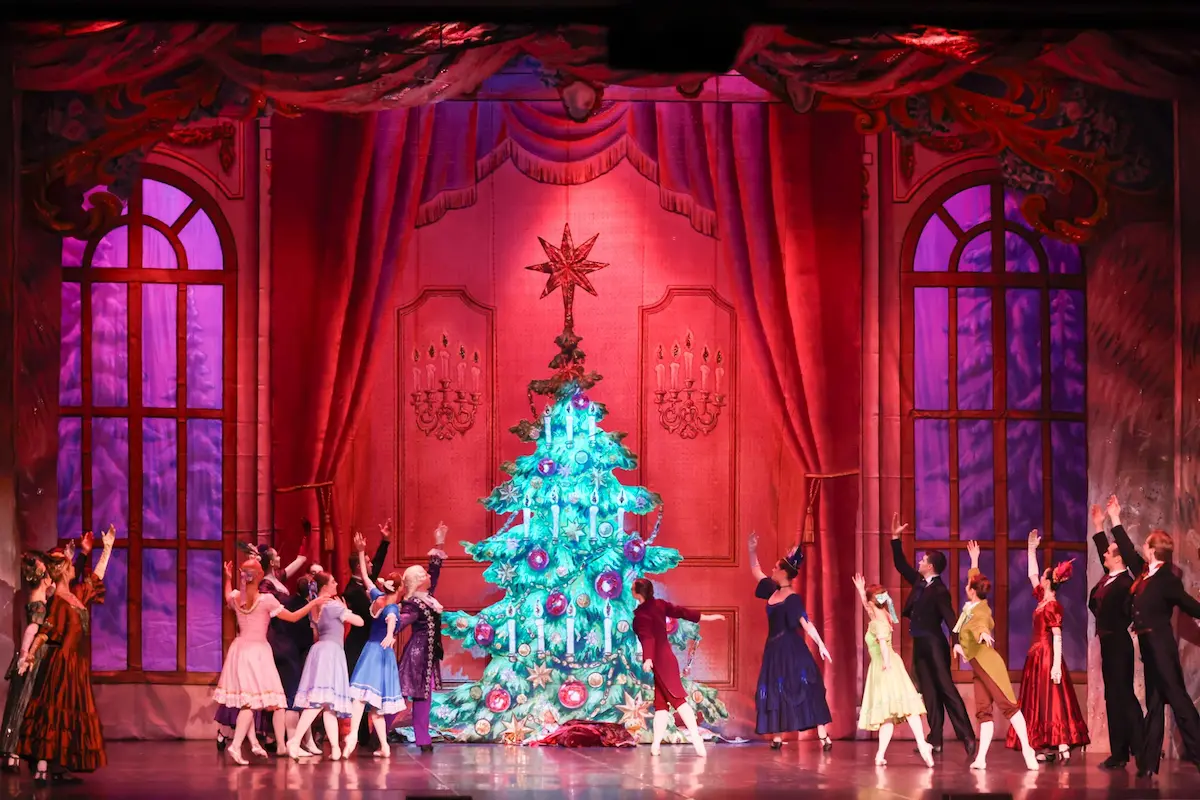
THE NUTCRACKER
Music by Pyotr Ilyich Tchaikovsky
Libretto of Marius Petipa in edition of Vladimir Troshenko
Based on the fairy tale by Ernst Hoffmann
“The Nutcracker and the Mouse King”
The fragments of choreography by Marius Petipa, Lev Ivanov, Alexander Gorsky, Vasily Vainonen, Anatoly Emelianov
Act One
Guests are invited to a New Year’s Holiday in the Stahlbaum’s house. Drosselmeyer is among them, he is the close friend of the owners of that house, the wizard and the storyteller. Children are in joyful expectation of the New Year’s gifts, the Christmas tree was lit by bright lights and the celebratory ball has begun. As soon as Drosselmeyer departs from the guests, children ask him to conjure and show them new toys. They are delighted by the clockwork dolls. He gives them a new doll of the ridiculous and inconsistent Nutcracker. Masha’s brother Fritz plays with it and then breaks it. Drosselmeyer repairs the Nutcracker and it dances with Masha again. The evening comes to an end. After the farewell dance , the visitors leave and the children go to sleep.
During the night the room is lit up with the mysterious moonlight. Masha sings lullabies to the doll and falls asleep next to the Nutcracker. She dreams that the dolls come alive and all the world changes. Suddenly there is a whole horde of mice led by the Mouse King. Dolls and toy-soldiers are in confusion. The brave Nutcracker together with the doll army enters the fight against the Mouse King and his pack, but they are unequally matched and the mice take the upper hand. At this stage Masha fires a cannon and the mice take flight.
The battlefield is now empty. The courageous Nutcracker has lost and Masha is in despair, but the miracle takes place and the amusing doll turns into a fine Prince, who carries away Masha in the surprising country of fairy tales. The Room turns to a blizzardy winter mood and the snow drifts to the ground in circles.
Act Two
Masha and the Nutcracker-Prince travel through the fantastic Kingdom but they are pursued by the Mouse King and his army who give battle, but the Prince emerges victorious. The great celebration begins in honor of the winner and the citizens of the fantasy kingdom greet the happy Prince and Masha who fall in love. Dolls from all over the world entertain the lovers.
The Spanish, Arabian, Chinese, Russian and French dolls dance for them. New Year’s Eve comes to an end. Having woken up in the room, Masha doesn’t find the Nutcracker-doll and she understands that it was a wonderful dream. Wizard Drosselmeyer, who has told these fantastic New Year’s dreams, returns the Nutcracker doll to Masha, which she has grown so fond of…
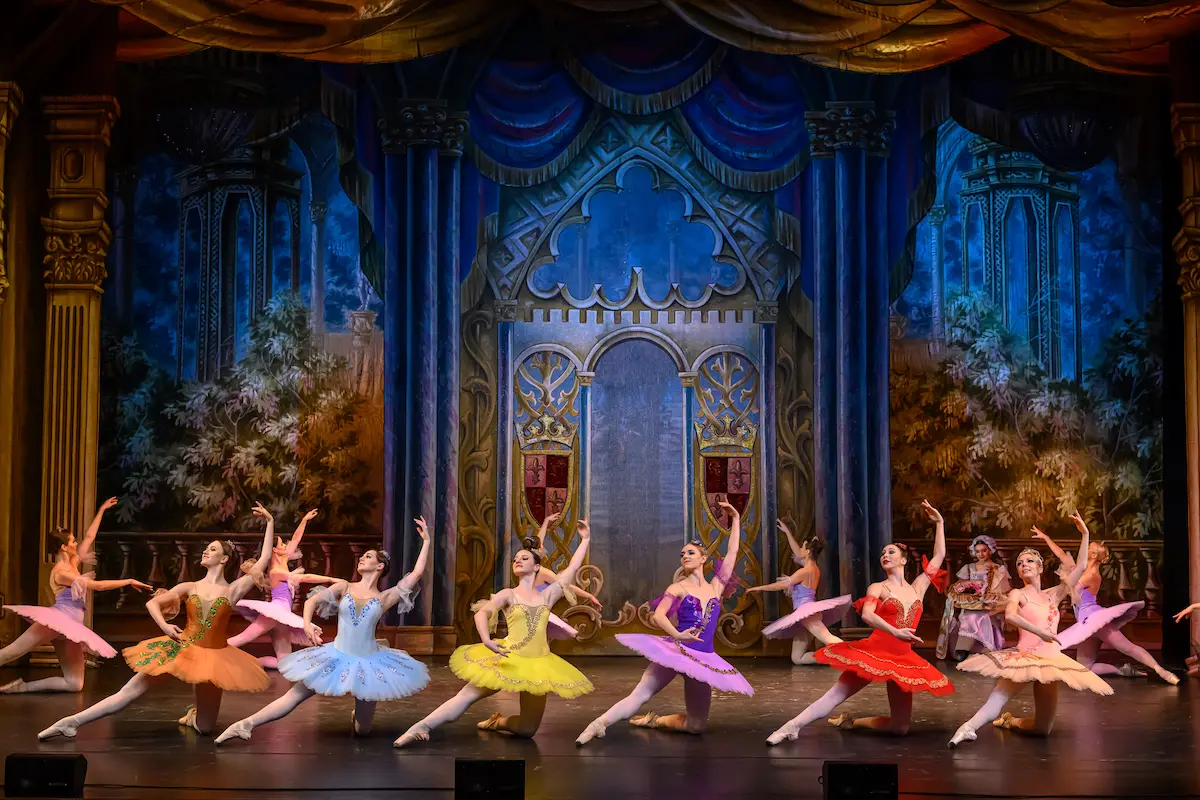
THE SLEEPING BEAUTY
Music by Pyotr Ilyich Tchaikovsky
Libretto by Ivan Vsevolozhsky and Marius Petipa based on the story of the same fairy tale by Charles Perrault
Choreography by Marius Petipa
Prologue
Room inside the Palace
King Florestan and his Queen are celebrating the christening of their daughter, Princess Aurora. The celebrations are suddenly interrupted and Catalabutte, the Master of Ceremonies responsible for compiling the guest list, realizes that he has neglected to invite the Fairy Carabosse. Carabosse appears with her entourage and swears that she will be avenged on them all, predicting that one day Aurora will prick her finger and die.
The Lilac Fairy appears and revokes the curse, promising that Aurora will not die but only fall asleep, to be awakened by a prince’s kiss after a hundred years. For fear of Aurora coming to any harm, King Florestan declares that, on pain of death, no sharp needles are ever to be allowed at court.
Act One
The Palace Gardens
The villagers are celebrating Princess Aurora’s sixteenth birthday with garlands and baskets of flowers. At the birthday celebrations, four princes seek her hand in marriage, and she dances with each of them. At the height of the celebrations, Carabosse, disguised as an old woman, gives Aurora a spindle. The Princess dances with the spindle and, pricking her finger, collapses as Carabosse reveals her true identity. Once more the Lilac Fairy appears, and as the Princess is carried outdoors, casts a spell of sleep over the whole court.
Act Two
The Forest
One hundred years later, Prince Florimund and his courtiers are hunting deer. Suddenly the Prince becomes melancholy, and sends his retinue to follow the hunt so that he may be alone. In his solitude he has a vision of Princess Aurora. Then, directed by the Lilac Fairy, the Prince journeys through the forest to King Florestan’s palace. There he finds Aurora asleep, and awakens her with a kiss. The whole court comes to life, and the King and Queen approve the betrothal of Princess Aurora and Prince Florimund.
The Palace Ballroom
The court celebrates the wedding of the Prince and Princess with a great ball. The fairy-tale characters of the Bluebird and Puss in Boots also come to pay their respects with special dances. Finally, the Prince and Princess dance together, and in a final celebration are joined by the whole court.
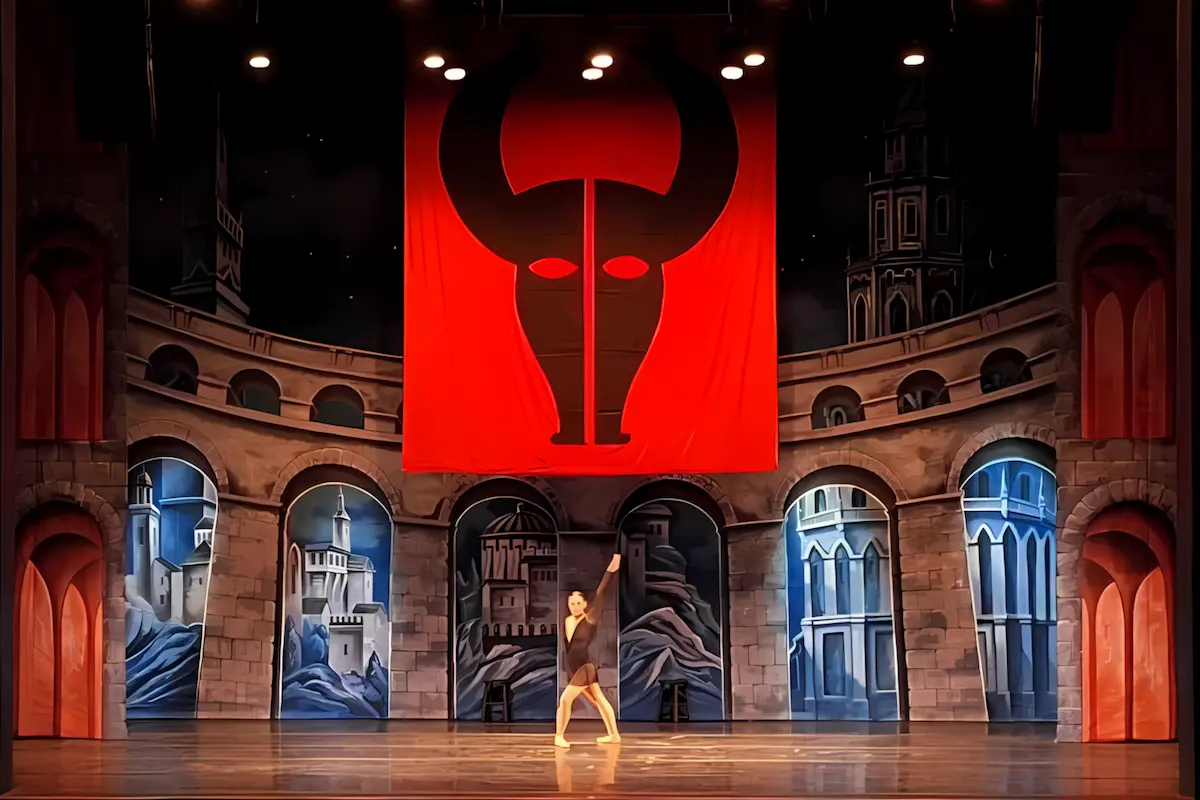
CARMEN SUITE
Music by Georges Bizet – Rodion Shchedrin
Libretto by Alberto Alonso in the novel by Prosper Merimee
Choreography by Alberto Alonso
“Carmen” by Georges Bizet. Almost a century and a half the image of Carmen irresistibly attracts many artists who embody it in verse and prose, in music and theater, in painting and cinema. For the first time the plot about the most famous and passionate gypsy became a fact-art in 1845, when the French writer Prosper Merimee wrote his novel. A year later the young choreographer Marius Petipa has created one-acted ballet “Carmen and Toreador” on stage of Madrid Theatre And 29 years later one of the most famous opera masterpieces – “Carmen” of Georges Bizet appears. Since then, the image of the Spanish gypsy is inextricably linked with the music of the great Frenchman.
In the XX century ballets using the score of Bizet, appeared regularly. Among the most famous are Carmen by Roland Petit, created by him in 1949 for Zizi Jeanmaire, and Stuttgart’s performance of 1971 by John Cranko, where Marcia Heide danced. Among less known – the choreographic opus of Americans R. Paige and B. Stoun called “Rifles and castanets.” It is almost unknown that in Russia in the 30s the same attempt was made by the choreographer-innovator Kasyan Goleizovsky.
In 1967, a new name appeared in the playbill of the Bolshoi Theater – the ballet “Carmen Suite”. Bizet’s music in the modern transcription of the composer Rodion Shchedrin, choreography by Alberto Alonso.
In the center of the ballet is the tragic fate of the Gypsy Carmen and the beloved soldier Jose, whom Carmen leaves for the sake of the young Torero. The relationship between the heroes and the death of Carmen at the hands of Jose is predetermined by Rock. Thus, the history of Carmen (in comparison with the literary source and the opera Bizet) is solved in a symbolic sense, which is strengthened by the unity of the place of action (the bullfighting platform).